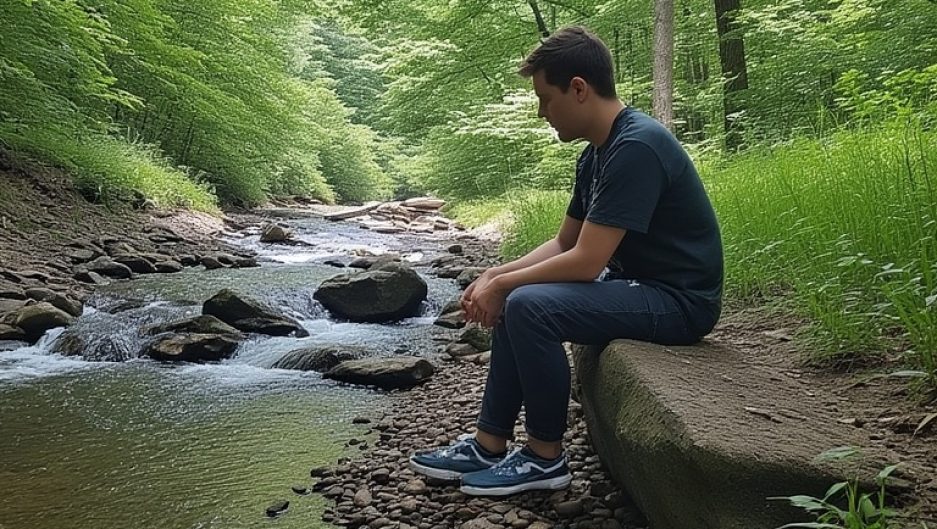

When we hear the word topography, we often think of maps. A map shows hills, valleys, rivers, and flat land. Now imagine making a map of something you cannot see or touch: silence. The topography of silence is a way to think about how quiet moments have shape, depth, and meaning in our lives. Silence is not just empty space. It has layers, borders, and hidden paths.
In social life, silence plays a big role in gossip. Gossip grows in noisy places—hallways, group chats, lunch tables—where words travel fast. But silence can slow gossip down or stop it completely. When someone chooses not to repeat a story, they are creating a quiet hill that blocks the spread. Other times, silence becomes a deep valley. If no one speaks up to correct a rumor, the quiet can make the gossip feel more powerful. This shows that silence is not always good or bad. Its shape depends on how people use it.
Silence is also important in the psychology of privacy. Privacy is like drawing a boundary on a map. Inside that boundary, thoughts and feelings are protected. Silence helps build those borders. When we do not share every detail about ourselves, we are shaping our own quiet space. For teenagers especially, privacy can feel confusing. Sharing can bring connection, but silence can bring safety. Learning when to speak and when to stay quiet is like learning how to read the land on a map. It takes practice.
Silence also appears in meditation and isolation. In meditation, silence is often gentle and wide, like an open field. There may still be sounds—a breath, a clock—but the mind learns not to chase them. This kind of silence can help people feel calm and focused. Isolation, however, can create a different shape. It can feel like a steep cliff or a closed cave. Too much silence without choice can feel lonely or heavy. Again, the topography changes based on how the silence is experienced.
Even music can teach us about silence. In minimalist music, there are long pauses and repeated patterns. The quiet parts are just as important as the notes. Silence gives the listener space to think and feel. Without those pauses, the music would feel crowded. This reminds us that silence can add meaning, not remove it.
Example of minimalistic music — https://youtu.be/heu9tD0dzkY?si=jmxirk4OhVnfNMu4
In the end, the topography of silence shows us that quiet is not nothing. It is a landscape we move through every day. By paying attention to its shapes—where it protects, where it harms, where it heals—we can learn to use silence wisely. Silence, like a map, helps us understand where we are and where we want to go.

 IT'S ME AGAIN
In the modern world, real silence is hard to find, and almost non-existent. Even in the remotest parts of the planet there are the sounds of nature, birds, and animals. I think total silence would actually be hard for us to deal with, and might drive us crazy.
Best wishes, Pete.
https://www.smithsonianmag.com/smart-news/earths-quietest-room-you-can-hear-yourself-blink-180948160/
LikeLike
Silence is the stuff of a sound mind…..chuq
LikeLike