
So Is It Or Not? You Decide.


When we hear the word topography, we often think of maps. A map shows hills, valleys, rivers, and flat land. Now imagine making a map of something you cannot see or touch: silence. The topography of silence is a way to think about how quiet moments have shape, depth, and meaning in our lives. Silence is not just empty space. It has layers, borders, and hidden paths.
In social life, silence plays a big role in gossip. Gossip grows in noisy places—hallways, group chats, lunch tables—where words travel fast. But silence can slow gossip down or stop it completely. When someone chooses not to repeat a story, they are creating a quiet hill that blocks the spread. Other times, silence becomes a deep valley. If no one speaks up to correct a rumor, the quiet can make the gossip feel more powerful. This shows that silence is not always good or bad. Its shape depends on how people use it.
Silence is also important in the psychology of privacy. Privacy is like drawing a boundary on a map. Inside that boundary, thoughts and feelings are protected. Silence helps build those borders. When we do not share every detail about ourselves, we are shaping our own quiet space. For teenagers especially, privacy can feel confusing. Sharing can bring connection, but silence can bring safety. Learning when to speak and when to stay quiet is like learning how to read the land on a map. It takes practice.
Silence also appears in meditation and isolation. In meditation, silence is often gentle and wide, like an open field. There may still be sounds—a breath, a clock—but the mind learns not to chase them. This kind of silence can help people feel calm and focused. Isolation, however, can create a different shape. It can feel like a steep cliff or a closed cave. Too much silence without choice can feel lonely or heavy. Again, the topography changes based on how the silence is experienced.
Even music can teach us about silence. In minimalist music, there are long pauses and repeated patterns. The quiet parts are just as important as the notes. Silence gives the listener space to think and feel. Without those pauses, the music would feel crowded. This reminds us that silence can add meaning, not remove it.
Example of minimalistic music — https://youtu.be/heu9tD0dzkY?si=jmxirk4OhVnfNMu4
In the end, the topography of silence shows us that quiet is not nothing. It is a landscape we move through every day. By paying attention to its shapes—where it protects, where it harms, where it heals—we can learn to use silence wisely. Silence, like a map, helps us understand where we are and where we want to go.
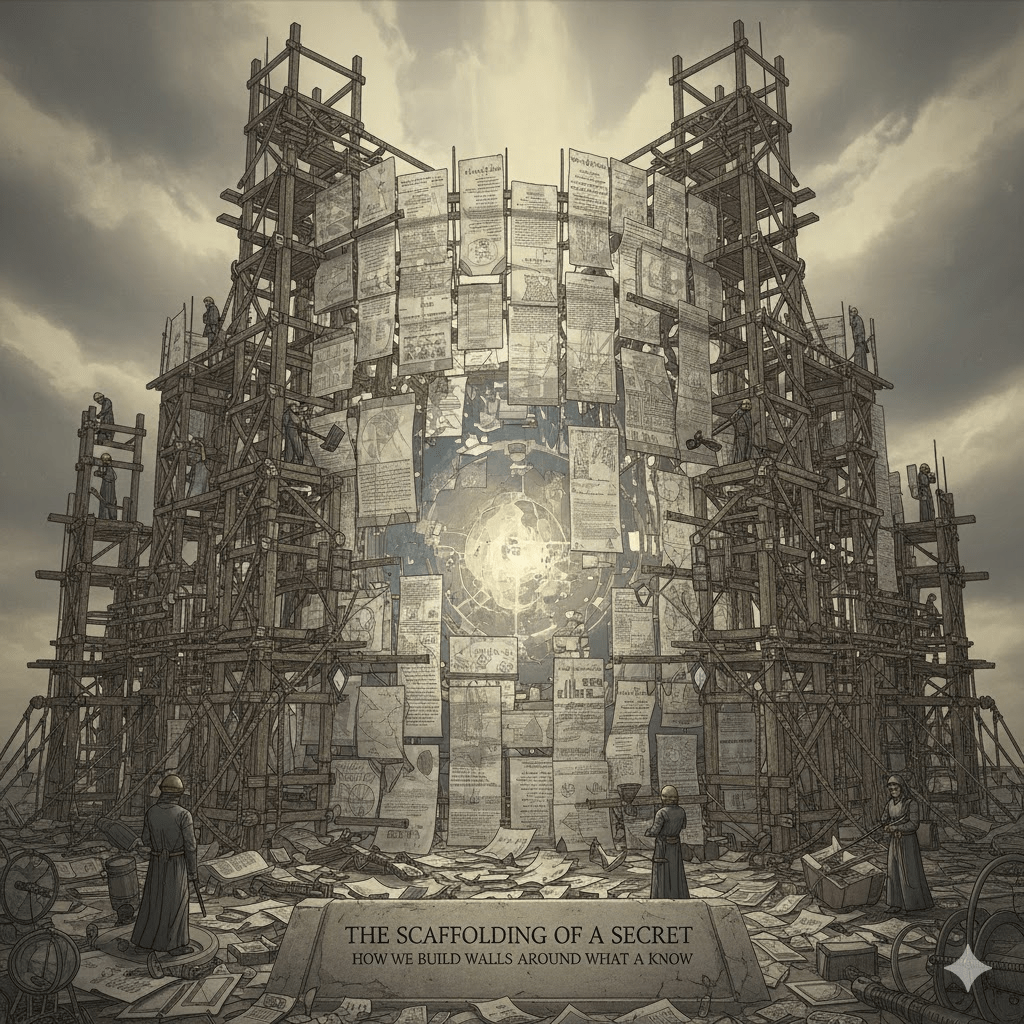
Have you ever had a piece of news that felt like it was burning a hole in your pocket? You know something that no one else knows, and for some reason, it makes you feel powerful and heavy at the same time. That feeling is the beginning of what we call the scaffolding of a secret.
Think of a secret like a house. To keep a house standing, you need a frame, walls, and a roof. Secrets work the same way. We don’t just “have” a secret; we build a structure around it to keep it safe from the outside world.
The foundation of any secret is privacy. This is the choice you make to keep a thought or an event just for yourself. Privacy is like having a bedroom with a door that locks. It’s your space. When you decide something is a secret, you are essentially saying, “This information belongs to me, and I’m not ready to share the key yet.”
Psychologically, this feels good because it gives us control. In a world where everyone is always posting on social media or talking in the hallways, having something that is only yours makes you feel like an individual.
The scaffolding starts to get complicated when we decide to tell just one person. We usually do this because keeping a secret alone is exhausting. It’s like holding up a heavy board by yourself; eventually, your arms get tired.
When you tell a best friend a secret, you are inviting them into the “scaffolding.” You are trusting them to help you hold up the weight. This creates a bond. In sociology (the study of how people act in groups), secrets are like “social glue.” They stick people together because now you both have something to protect.
This is where the structure can fall apart. If the scaffolding is built out of gossip, it’s not very strong. Gossip is when we share a secret that wasn’t ours to tell.
Why do we do it? Usually, it’s because sharing a secret makes us feel important. For a few minutes, we are the center of attention. But here’s the catch: once you use a secret as gossip, you’ve broken the walls. The “house” collapses. The person who trusted you now feels exposed, and the “glue” that held your friendship together turns into something messy and hurtful.
We build the scaffolding of secrets to protect our reputation, to fit in, or to keep our friends safe. But we have to be careful. If you build too many walls around yourself, you might end up feeling lonely. If you tear down someone else’s walls by gossiping, you lose their trust.
The Bottom Line: A secret isn’t just a piece of information. It’s a structure built on trust. Before you add another person to your scaffolding, or before you knock someone else’s down, ask yourself if the structure is built to protect someone or to hurt them.

We often envy the fictional protagonist who can manipulate the clock—someone who freezes a chaotic moment to find clarity or rewinds a blunder to refine their response. While the laws of physics remain rigid, the human mind is naturally non-linear. We possess a cognitive “remote control” that allows us to navigate our experiences through three distinct internal modes: Reflection, Presence, and Projection.
When we revisit the past, we aren’t just reminiscing; we are performing a “mental autopsy” on our experiences. By re-examining a conversation or a failure from a fresh perspective, we essentially edit our internal software. We cannot change what happened, but we can change the meaning we derive from it, ensuring the next “take” of our lives is more informed than the last.
In a world addicted to speed, the ability to “pause” is a competitive advantage. This isn’t about stopping the world, but about widening the gap between a stimulus and your response. Whether through a deep breath, a walk, or a moment of silence, pausing allows the “noise” of life to settle. It transforms us from reactive participants into deliberate architects of our next move.
The most sophisticated power we possess is the ability to leap into the future. We don’t do this through prophecy, but through structured speculation. One of the most effective frameworks for this is Morphological Analysis (MA).
Rather than waiting for a “lightbulb moment,” MA allows you to engineer one by deconstructing a problem into its fundamental building blocks.
By systematically mixing these attributes, you are essentially “fast-forwarding” through hundreds of potential futures in a matter of minutes. You identify the dead ends before you ever walk down them and spot the breakthroughs that others miss because they are thinking linearly.
We are all time travelers in the theater of our minds. By treating memory as a classroom, the present as a sanctuary, and the future as a laboratory of combinations, we move beyond the limits of the clock. We don’t need supernatural powers to reshape our reality; we simply need to use the structured imagination we already possess.

For over twelve years now, I’ve been laboring to keep this blog alive. It hasn’t always been easy—there have been days when I’ve wondered if anyone is even out there, reading what I write. But despite that, I’ve been truly blessed with a small, loyal group of readers—five or six, to be exact—who have stuck with me through thick and thin. These are the ones who have endured my eccentricities, my shifts in direction, and my constant experimentation with new ways of telling stories. It’s because of them that I keep going, knowing that, no matter how small the audience, someone is out there appreciating what I do.
You see, this blog hasn’t just been a place to write; it’s been a living, breathing entity that I’ve poured my heart and soul into. In these years, I’ve explored so many different directions—whether it’s through stories, musings, or deep dives into various topics—and each post feels like a little piece of me, a small offering to the world. But through all of it, I’ve struggled with finding a proper niche, that sweet spot where my voice feels not only authentic but also valuable to a broader audience. It’s like I’m constantly searching for the best way to present my stories, for the right combination of words that will resonate with someone, somewhere.
I won’t lie; there are times when the whole process feels overwhelming. Writing better, being more efficient, learning new techniques to craft my words—it’s all part of the continuous learning curve that never seems to end. But in some ways, that’s the joy of it too. Even when I feel like I’ve mastered something, there’s always more to discover, more ways to improve. And that keeps me going.
Yet, the world of blogging isn’t what it used to be. Over the years, I’ve watched as algorithms and SEO tactics have taken over the game. It’s not enough to write from the heart anymore. Instead, you need to optimize everything, make sure you’ve got the right keywords, the right formatting, and the right timing to get noticed. It’s become a strange dance, and sometimes I find myself wondering if my work is more about pleasing algorithms than connecting with readers on a deeper level.
And then there’s the financial side. I spend a significant amount of money each year keeping this blog running. Hosting, domain renewal, maintenance—these things add up, but I’ve always believed in the value of what I’m doing here. I see this blog as an investment, not just in myself but in my readers too. I’m committed to making it better, more engaging, and more impactful with every post. But let’s be real: it’s not cheap, and it’s not easy. If I could somehow syndicate this blog without spending a fortune, I would, but the costs of reaching a wider audience always seem to hover just out of reach.
Still, I do it because I believe in this community, in the connection we’ve built over the years. And I want to take a moment to sincerely thank every single one of you who has stuck with me. Whether you’ve been here for months or for years, your loyalty has meant the world to me. Without you, this blog would just be a collection of words floating in the void. But with you, it’s a place where I can share my thoughts, ideas, and stories with a supportive and thoughtful audience.
As we look ahead, I want to promise you this: better things are coming. I’m working on new ways to present my stories, new techniques to improve the quality of my writing, and new ideas to make this space even more engaging. I’m not done yet. We’ve got a long road ahead, and I’m incredibly excited to see where it takes us. Thank you, from the bottom of my heart, for being a part of this journey.
I couldn’t do it without you.
 IT'S ME AGAIN