
Why Even Bother To Look Inward

I have a habit of taking myself apart in quiet moments. I examine my reactions, replay conversations, question motives, and probe the emotional weather inside my own mind. What I have never been able to pin down is why I do it. The impulse feels ancient and automatic, like breathing or scanning the horizon. Yet when I zoom out far enough—past my daily concerns, past my lifetime, past the thin skin of this planet—I run into a contradiction. In a universe that stretches beyond comprehension, where entire galaxies drift like dust motes, how do I justify assigning myself any special weight at all?

This tension sits at the heart of self-analysis. On one hand, introspection feels essential, even noble. On the other, cosmic perspective threatens to dissolve the very idea that the self is worth studying. And yet, we persist. Perhaps the answer lies not in self-importance, but in self-responsibility.

Recognizing our smallness does not erase our inner lives. If anything, it sharpens them. We may be insignificant to the universe, but we are not insignificant to each other. The thoughts we think, the choices we make, and the ways we treat others ripple outward in tangible ways. Self-reflection, then, may not be about elevating the self above the cosmos, but about understanding the instrument through which our limited influence flows.

Effective self-reflection begins with honesty, but not cruelty. Many people confuse introspection with self-criticism, turning analysis into a courtroom where the verdict is always guilt. A more useful approach is curiosity. Instead of asking, “What is wrong with me?” we can ask, “What is happening here?” This subtle shift changes the tone from judgment to investigation. Curiosity opens doors that shame keeps locked.

One practical method is reflective writing. Putting thoughts on paper slows them down and gives them shape. Patterns emerge that are invisible in the mental churn of the mind. Writing without an audience—no polishing, no performance—allows truths to surface unfiltered. Over time, these entries become a map of recurring fears, desires, and values. The goal is not to document every thought, but to notice which ones keep returning.

Another powerful tool is emotional labeling. Many of us move through life with vague sensations of “good” or “bad” without naming what we feel. Research and experience both suggest that naming emotions reduces their intensity and increases our ability to respond thoughtfully. Saying “I feel threatened” or “I feel overlooked” is far more actionable than carrying a nameless weight. Precision creates agency.

Mindful pauses also play a critical role. Self-analysis does not require hours of meditation on a mountaintop. It can happen in brief moments of interruption: before responding defensively, after feeling a surge of irritation, or when a sense of unease appears without explanation. Asking a single question—“What just got touched inside me?”—can reveal more than an entire afternoon of overthinking.

Yet reflection alone is incomplete. Insight that never leaves the mind can become a loop, endlessly revisiting the same terrain. The real value of self-analysis lies in translation: turning understanding into action. This begins by identifying what is within our control. We cannot rewrite our past or manage others’ behavior, but we can adjust how we respond, what boundaries we set, and which habits we cultivate.

One effective strategy is to convert insights into small experiments. Instead of declaring sweeping changes—“I will be a better person”—we can test modest shifts. If reflection reveals a tendency to avoid difficult conversations, the experiment might be to speak honestly in one low-stakes situation. If we notice a habit of assuming negative intent, the experiment might be to pause and consider two alternative explanations before reacting. These small trials reduce the pressure of perfection and make growth tangible.

Importantly, self-reflection gains depth when it extends beyond the self. Understanding our triggers, biases, and wounds equips us to meet others with greater compassion. When we recognize our own fear of rejection, we become gentler with someone who lashes out. When we see how easily we misinterpret silence, we are less likely to assume malice. In this way, self-knowledge becomes a bridge rather than a mirror.

Helping others does not require grand gestures. Often, it is expressed through restraint: listening instead of interrupting, responding instead of reacting, choosing clarity over defensiveness. These choices are born from self-awareness. They acknowledge our smallness while honoring our responsibility to the shared human space we occupy.

Perhaps the reason we analyze ourselves is not to prove that we matter in a vast universe, but to ensure that, in the brief moment we are here, we do as little harm and as much good as possible. Self-reflection is not an act of self-importance; it is an act of stewardship. We may be tiny, but we are not careless. And that, in a universe this large, may be reason enough to look inward.
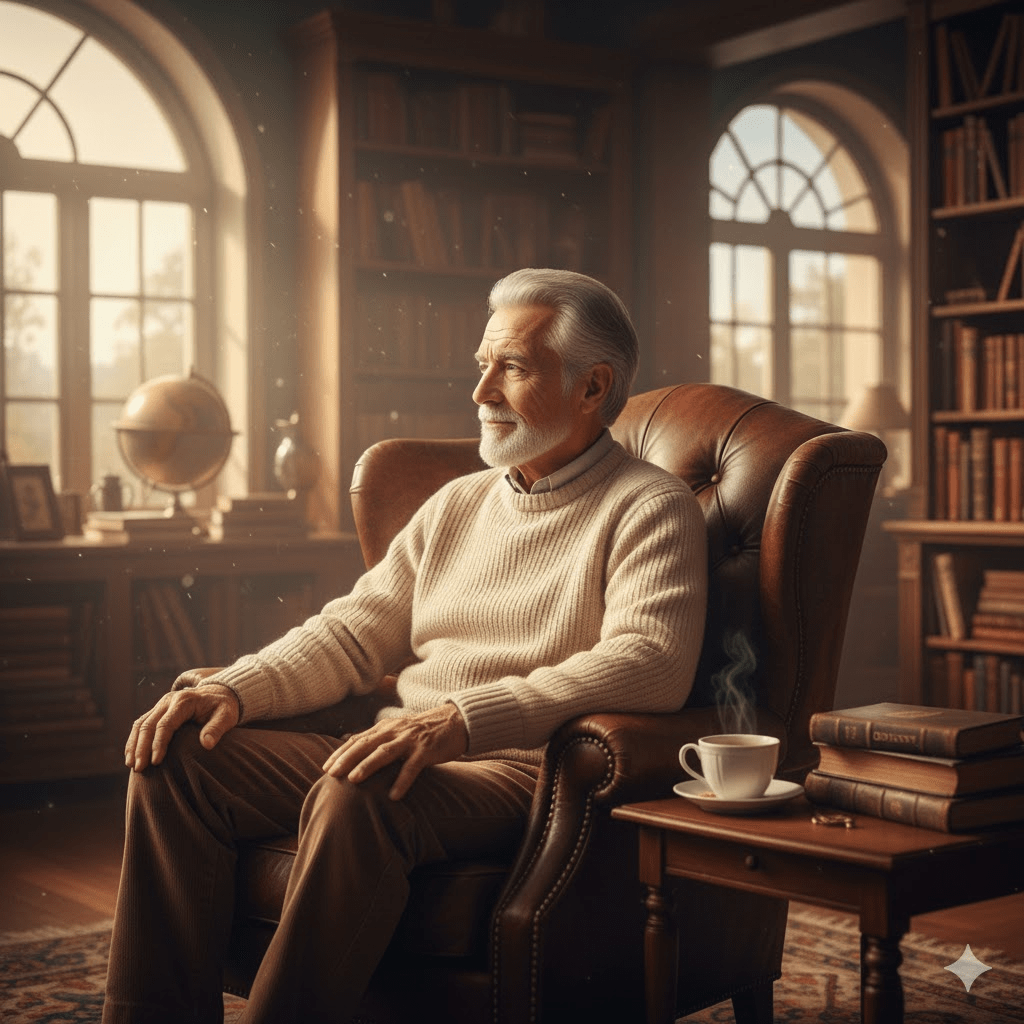
Sitting, Thinking, and Recovering: Musings of an Old Guy

This is not me; This is an artificially-generated image (By Gemini AI)

Here I am, sitting in my chair, typing away with nothing particularly pressing on my mind. That’s become a pretty normal experience for me these days. Thoughts don’t flow as easily as they once did, and I’ve come to accept that. My mind isn’t as quick or nimble as it used to be, and my thinking has become more deliberate, more measured. These days, most of the thoughts I entertain are the kinds that I guess most older folks think about: health, wealth, politics, sickness, and well… flatulence. Yes, even flatulence makes the mental rounds—there’s no escaping it as one ages.

In spite of that, I like to think I’m in reasonably good shape for an old guy. I’m currently in the ninth week of recovery from a truly miserable bout with a disease called C. difficile, or C-diff for short. For those unfamiliar, it’s a nasty gut infection that left me bedridden and questioning the universe for a while. The irony is that I got it because a “doctor”—and I use the term loosely—decided to prescribe a heavy-duty antibiotic for an ear infection without bothering to run any lab work to see if an infection even existed. That was a mistake that nearly cost me my comfort, if not more.

But time, as it tends to do, has moved on. I’m recovering steadily, and I’m grateful for that. I’ve learned to appreciate the small victories: a day without pain, a meal that sits well in my stomach, the ability to walk down the street without fatigue. These are the things that matter now, more than the endless ambitions and worries of my younger years.

Despite the lingering effects of C-diff, life retains its small pleasures. I love my afternoon naps, though it’s funny because even with these daily siestas, I still sleep well at night. There’s something deeply comforting about this rhythm—the slow, gentle slide from wakefulness to rest and back again. In the winter, when the weather turns cold and the world outside seems inhospitable, I have my fortress of warmth: a reliable heating furnace and a mountain of blankets that I can snuggle under to my heart’s content. Simple comforts, but priceless ones.

Looking outward, the political landscape is, well… chaotic. It seems like the world has gone off the rails in so many ways, and yet, I remain largely unaffected on a day-to-day basis. I still live freely; nobody on the street is demanding to see my papers. I have food in the house, clothing on my back, enough money to live comfortably. In the grand scheme of things, that’s a lot to be thankful for. Politics may rage and divide, but my little corner of the world remains relatively stable, and I cling to that.

I’ve never been one to spend much energy complaining about politics. The system feels distant, unyielding, and sometimes performative, no matter the election cycle. We go to the polls, we vote in these “pretend” elections, and then life moves forward with minimal acknowledgment of our effort. And yet, even in this apparent futility, there is a strange sense of peace. Accepting what I cannot change has become something of a pastime in itself. It’s not apathy; it’s survival. It’s knowing that my energy is better spent on the things I can control—my health, my comfort, my small routines.

I think there’s a freedom that comes with age. Younger folks chase dreams, ambitions, accolades, and status. As you get older, you realize that happiness often hides in the ordinary moments: a warm blanket, a good nap, a quiet morning without demands. I’ve come to embrace these simple pleasures because they are real, tangible, and entirely mine. They don’t require anyone else’s approval, and they don’t fluctuate with the news cycle or stock market.

Of course, this is not to say that age comes without its frustrations. The body does its best to remind you of its limitations, and the mind occasionally drifts into realms of worry about health, finances, and the state of the world. But those thoughts are now tempered by experience. I’ve learned that time will pass regardless of fretting or fussing. The key is to navigate life with as much grace and humor as possible. Hence, the occasional chuckle at flatulence or at the absurdity of some political spectacle. Humor keeps the mind light and the heart from hardening.

As I sit here, typing with nothing especially on my mind, I recognize that this very act is a kind of meditation. The simple act of putting thoughts into words, of recording a moment in time, feels strangely profound. It’s a small rebellion against the erosion of memory, a way to mark that I was here, thinking, recovering, living. The details of daily life—the mundane, the irritating, the comforting—become a tapestry of existence, stitched together with patience and resilience.

So yes, my thoughts may wander to health, politics, and bodily functions. They may meander with no particular purpose. But in this wandering, there is a quiet satisfaction. The world may be chaotic, the body may protest, and the mind may occasionally falter, but the simple pleasures remain. Naps, warmth, food, freedom, and a sense of humor—they are enough. For an old guy like me, they are more than enough.

And as the winter wind howls outside, I sit here, content in my chair, typing away with nothing especially on my mind. It’s a normal day, and that’s perfectly fine.