
Image created by GEMINI artificial intelligence… no real people represented here.
I lived in the days before anybody ever heard about Food Stamps or SNAP programs and we were classed as being “Poor” and we got through the hard times alright because my Dad worked, My Grandfather worked and My Mom worked. All their jobs were menial and low paying but somehow we managed to keep the roof over our heads, food in our bellies, clothes on our backs and remain fairly healthy.
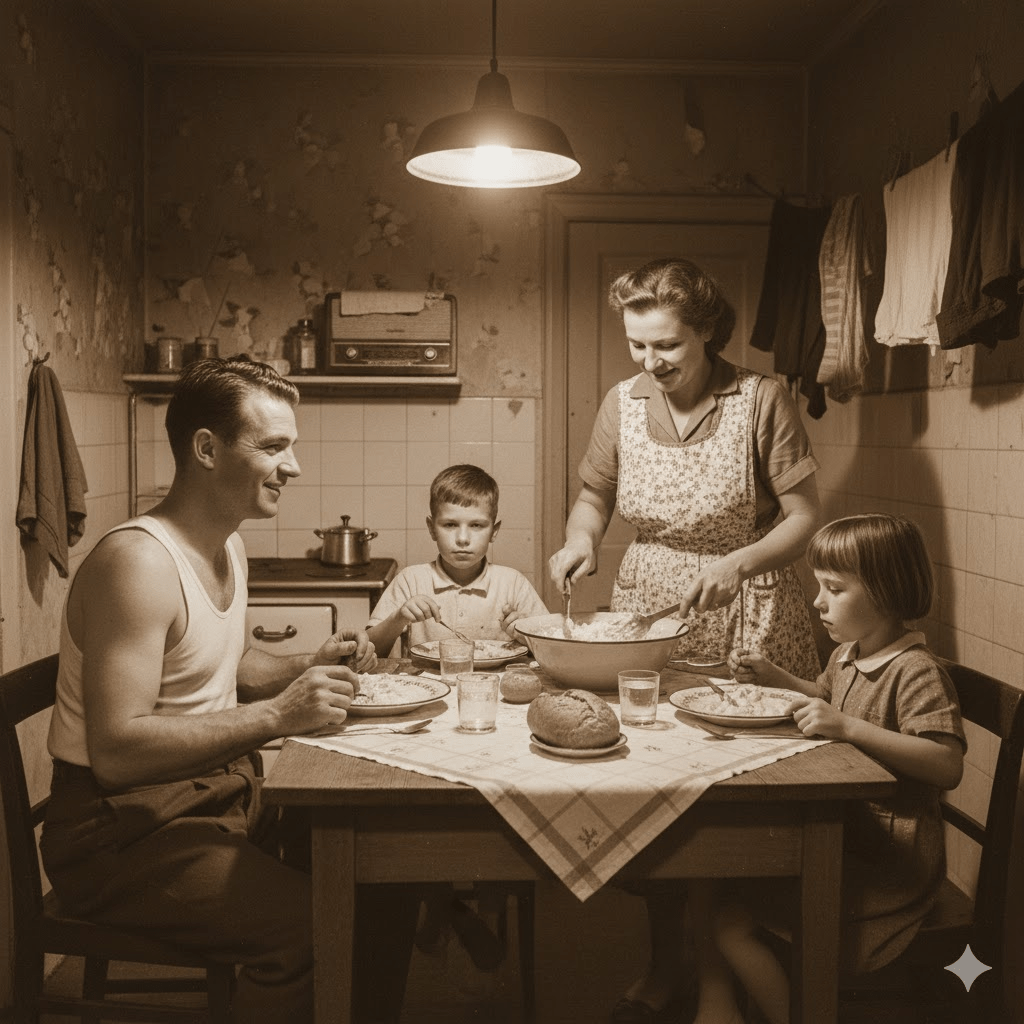
The food was simple but nutritious and plentiful regardless of hard times.
Now people get all up-tight and out of sorts when the President threatens to withhold funds for the SNAP program and a horde of media go all hysterical and complain about it.
I cannot help but wonder what people would do today about food being short at their homes if there never had been a SNAP program or any other free food giveaways.
We just recently had a long government shut down and millions of people were supposed to starve for lack of their SNAP benefits but it looks like they all came through alright and i am thinking that if the SNAP program and related programs were to just disappear or be taken away altogether, resourceful Americans would find a way to fill the vacuum and help those who need the help.
HERE IS WHAT IT USED TO LOOK LIKE IN THE GOOD OLD DAYS
Section 1: The “Make Do” Economy (Individual Survival)
The first line of defense was never the government; it was the household’s ability to scrap, save, and negotiate.
- The Grocer’s Ledger (Informal Credit):
- How it worked: In the days before chain supermarkets, most people shopped at small, locally owned grocery stores. If a family was short on cash, they would ask the grocer to “put it on the tab.”
- The Social Cost: This wasn’t a right; it was a relationship. The grocer acted as a judge of character. If he thought you were a “good” family down on your luck, you ate. If he thought you were a drunkard or lazy, you starved. This created a massive power imbalance where poor families had to be unfailingly polite and subservient to the shopkeeper.
- Subsistence Farming & Foraging:
- Even in towns, many families kept chickens or a small garden (often called “thrift gardens” or “relief gardens” during the Depression).
- Hunting wasn’t a sport; it was a necessity. Rabbit, squirrel, and fish were standard protein sources for rural families when the store meat was too expensive.
Section 2: Community & Charity (The Private Safety Net)
When the household failed, the community stepped in. This was a patchwork system that varied wildly depending on where you lived and your race or religion.
- Mutual Aid Societies:
- What they were: Marginalized groups (especially Black, Italian, and Jewish immigrant communities) often couldn’t rely on white-run charities. They formed “Mutual Aid Societies”—members paid small monthly dues, and if a member lost their job or got sick, the society paid out funds to buy food.
- Rent Parties: In Harlem and Chicago, families would host parties with cheap admission and food to raise money to pay the grocer or the landlord.
- Churches and “The Lady Bountiful”:
- Churches were the primary food banks. However, aid often came with a sermon or a check on your “moral standing.”
- Wealthy women’s clubs often distributed baskets of food to the “worthy poor” (widows and orphans), but frequently excluded able-bodied men who couldn’t find work, viewing them as “undeserving.”
Section 3: The Public Spectacle (Depression-Era Relief)
During the Great Depression, private charity collapsed under the sheer volume of need. This led to the iconic, visible forms of hunger relief.
- Soup Kitchens & Breadlines:
- These were often run by religious missions or even notorious figures (Al Capone ran one of Chicago’s biggest soup kitchens).
- The Menu: It was almost always soup because water could be added to stretch it infinitely. Bread was stale or day-old donations from bakeries.
- The Shame: Standing in a breadline was a public admission of failure. Men would often pull their hats down low to avoid being recognized by neighbors.
- The “Penny Restaurant”:
- In some cities, local governments set up canteens where a meal could be bought for a penny or a nickel. It wasn’t free, but it was subsidized enough to be accessible to almost anyone with any cash.
Section 4: The Dreaded “Indoor Relief” (Government Action)
Before federal programs, welfare was local (county or city level) and was divided into “Outdoor Relief” and “Indoor Relief.”
- Outdoor Relief (The Handout):
- A local “Overseer of the Poor” might give a family a scrip (voucher) for a specific amount of coal or flour. It was humiliating and public; your name was often published in the town newspaper as a pauper.
- The Poor Farm (Indoor Relief):
- This was the ultimate threat. If you could not feed yourself, the county could force you to move to a “Poor Farm” or “Almshouse.”
- You would live in a dormitory, work the farm land to pay for your keep, and eat gruel. It was essentially a prison for being poor. Families would starve themselves for weeks rather than go to the Poor Farm.
Section 5: The Precursor (Surplus Commodities)
Just before the first food stamps (orange and blue stamps) were introduced in 1939, the government tried Direct Commodity Distribution.
- The “Cheese Lines”: Instead of giving people money to buy what they needed, the government bought excess farm goods (to help farmers keep prices up) and literally dropped them off at distribution centers.
- The Problem: A family might get a 5lb block of cheese, a sack of flour, and 10lbs of dried beans. They didn’t get milk, fresh vegetables, or meat. It was a “take what you get” system that ignored nutritional balance or dietary restrictions.

 IT'S ME AGAIN
That’s a good historical insight, John. One of my enduring memories of being a child in the 1950s was that nothing was wasted. We ate leftovers conjured up into looking like a different meal, and my mum also made her own pastry and cakes with whatever ingredients she had left lying around. My mum and dad were both paid in cash weekly, and after putting some money in a jar for running the car, electricity, and rent, the rest was spent on food. Any change from that was saved to buy clothes later.
Best wishes, Pete.
LikeLike
Eventually these aid stations will run out of people and donations…..and then we can we visit this. chuq
LikeLike
The point of the post is that there were no aid stations and donations back in the day and people still got along alright…I do not ever remember hearing of a single case where an American starved to death because of a lack of food in the 1930s or 40s and my parents would surely have talked about it.
LikeLiked by 1 person
People took care of their neighbors something that is sadly lacking these days…..my grandfather talked about on the Rez people that died from the cold and a lack of food….but that was Native Americans. chuq
LikeLike
Native Americans on reservations have always had a completely different history from our own…I am talking about citizens living in cities and towns like the ones where I grew up in—
LikeLiked by 1 person